Antrodia cinnamomea is a kind of fungus unique to Taiwan. A kind of perennial mushroom, it can be plate-shaped, bell-shaped, horseshoe-shaped, or tower-shaped; it is bright red when born and gradually changes to light reddish brown, light brown, or light yellowish brown. As a result, it is dubbed "the ruby of the forest” and gives out a strong bitter taste when held in the mouth. According to its parts, it can be divided into the fruiting body and the mycelium. The former is the reproductive organ of the mushroom, while the latter is the organ that absorbs nutrients and is made up of hyphae, which will develop and differentiate to form the fruiting body after absorbing nutrients. Some special Antrodia cinnamomea can also be white or yellow.
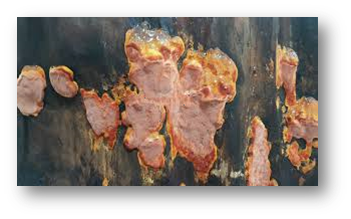
Antrodia cinnamomea is a species endemic to Taiwan. Within its natural surroundings, it only grows in the inner hollow wall of the trunk or other dark wet surface of the cinnamomum kanehirae Hayata, a large broad-leaved evergreen tree that grows only in Taiwan at an altitude of 200 to 1500 meters. As for Antrodia cinnamomea, it is a unique humus fungus from cinnamomum camphora.
Antrodia cinnamomea (fruiting body) flourishes from mid-May to late October each year, and slowly enters dormancy after November. the aforementioned period is the most important for mature Antrodia cinnamomea to convert and transform nutrients in the body into triterpenoids.
Triterpenoids, superoxide dismutase (SOD), adenosine, polysaccharides, protein, vitamins, nucleic acids, amino acids, lectins, lignin, antcin, trace elements
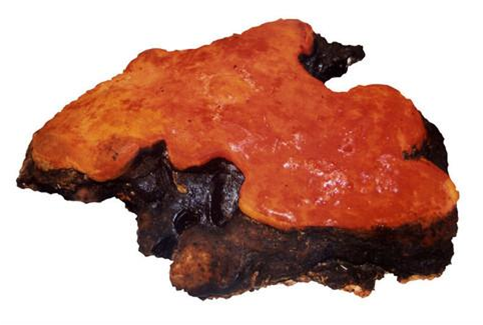
The source of bitterness in Antrodia cinnamomea extract
These ingredients could inhibit cancer cell growth and histamine release, prevent allergies, promote liver function and platelet aggregation, lower blood lipids and blood pressure, and suppress
Superoxide dismutase (SOD)
The ingredient is effective on anti-oxidation, anti-aging, removing free radicals, restoring skin luster, and reducing wrinkles and spots.
The ingredient is a kind of inhibitory neurotransmitter that can promote sleep.
β-D-glucan (β-D-glucan): enhances immunity function and achieves an anti-tumor effect (Mizuno, 1995).
With Sulfated polysaccharides: anti-tumor, anti-inflammation, immunomodulatory effect, AIDS treatment, anti-platelet aggregation, anti-thrombotic aggregation
This is a kind of alcohol in glycoproteins and promotes highly specific protein-binding
Stabilizing substance for blood pressure.
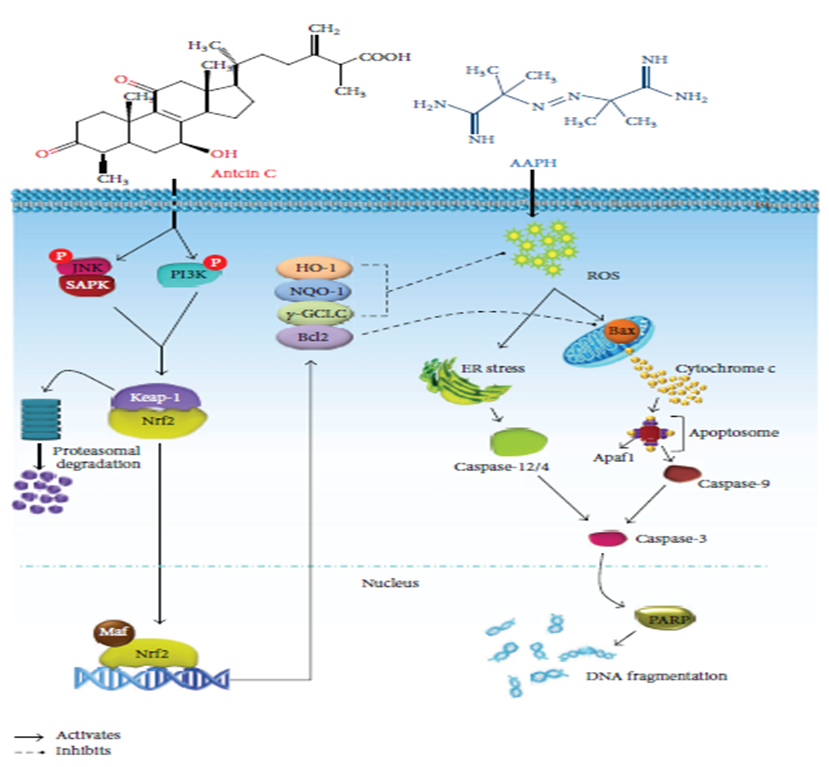
Antcin C induces the activation of antioxidant genes through the Nrf2 pathway, thereby protecting liver cells from cell damage caused by free radicals and superoxide ion clusters (ROS).
2003:Separation of active ingredients and confirmation of strain characteristics of Antrodia cinnamomea.
2004:Publication- High-throughput screening of Antrodia cinnamomea mycelium anti-hepatocarcinoma lead drug compound 2. Using p53, bax, bcl-2 m-RNA level to carry out anti-hepatocarcinoma lead drug compound, to explore the apoptosis pathway of human liver cancer cell line HepG2.
2008:Publication- The study of chemical structure and biological activity of γ-dodecalactone
2009:Publication- Structure and functions of gamma-dodecalactone isolated from Antrodia camphorata for NK cell activation.
2012:Research results of traditional Chinese medicine published- Epigenomics, proteomics and system biology analysis of drugs that induce cellular immune activity by Antrodia cinnamomea essential oil
2020:TFDA approval letter: The 90-day feeding toxicity testing of powder from fruit body of Antrodia cinnamomea
Aquilaria is a genus of Aquilaria from the Thymelaeaceae family; its scientific name is Aquilaria agallocha Roxb. Aquilaria crassma Pierre et LeCome/Aquilaria malaccensis is commonly known as Aquilaria and refers to the fusion of resin and wood from Aquilaria plants. The wooden part merged with these foreign substances is called "agarwood," while the cortex part is called "agarwood bark."
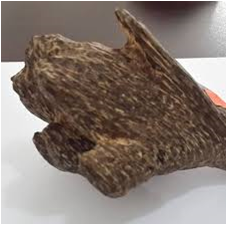
Agarwood originally came from Southeast Asia, while India is one of the earliest countries to export it. Currently, the main production places are Vietnam, Thailand, Laos, India, Indonesia, and Malaysia.
| There are more than four techniques to produce agarwood. |
| 1. The whole-tree agarwood-inducing technique (Agar-Wit). |
| 2. The partly-trunk-prunning method (PTP). . |
| 3. The burning-chisel-drilling method (BCD). |
| 4. The fungi-inoculation method |

Agarwood has CNS inhibitory effects

Agarwood has anti-arrhythmia and anti-myocardial ischemia effects

Agarwood has sedative and anti-asthmatic effects

Agarwood has the effect of ease temper and bad mood, can reduce the generation of free radical oxidants, and reduce the oxidation capacity. Relieve stress and concentrate on peace of mind.

Agarwood essential oil molecules have strong penetrating power, can be inhaled by smell or absorbed by skin, can promote blood circulation, improve secretion, delay cell aging, and repair skin

Agarwood also has anti-tumor effects
Wheatgrass is a genus of Agropyron and is considered a unique wheat. When ripe, it turns into red wheat berries, especially the young shoots of Agropyron cristatum (a kind of wheat). The young leaves can be squeezed or dried and ground. The unprocessed plant contains a lot of cellulose but is difficult for humans to digest. However, it also contains chlorophyll, amino acids, vitamins, minerals, etc.
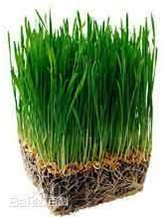
Wheatgrass can be cultivated using two methods: the hydroponic method where it is grown directly in cultivation soil and the method of planting and growing in traditional soil. The hydroponic wheatgrass produces more juice and has a strong flavor, although many people find it might cause nausea and dizziness upon drinking. As for the wheatgrass planted in the soil, it gives less juice.
Chlorophyll, minerals, enzymes, polysaccharides, vitamins, protein, crude fiber, amino acids, trace elements, bioflavonoids
Wheatgrass contains chlorophyll, which gives the plant the ability to prevent acidosis. Chlorophyll has also been proven to help balance pH levels and protect cells in the body.
Barley sprouts contain hundreds of active enzymes, of which the more important ones are: superoxide dismutase (SOD), cytochrome oxidase, lipase, protease, amylase, catalase, nitrogen-based oxygenase, and aspartate aminotransferase.
Mucopolysaccharides have been confirmed as an anti-cancer substance, while Gramineous plants contain mucopolysaccharides, the content of which is particularly high in rye leaves.
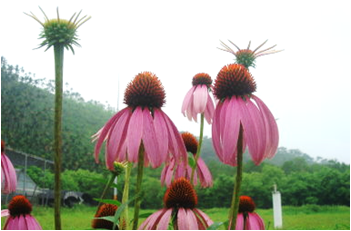
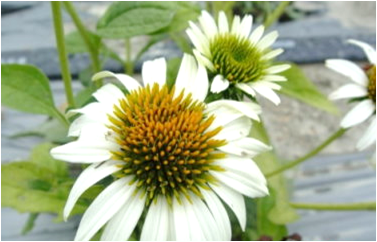
Echinacea purpurea (eastern purple coneflower, purple coneflower, hedgehog coneflower, or echinacea) is a North American species of flowering plant in the sunflower family. It is native to parts of eastern North America and present to some extent in the wild in much of the eastern, southeastern and midwestern United States as well as in the Canadian Province of Ontario. It is most common in the Ozarks and in the Mississippi/Ohio Valley. Its habitats include dry open woods, prairies and barrens.
Cymbopogon nardus, common name citronella grass, is a perennial aromatic plant from the family Poaceae, originating in tropical Asia. It is the source of an essential oil known as "citronella oil". It cannot be eaten because of its unpalatable nature. It’s an invasive species that renders pastureland useless as cattle will starve even in its abundance.
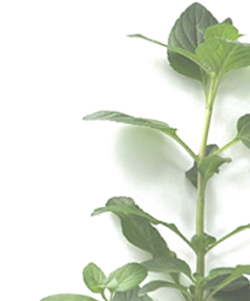
Nepeta cataria, commonly known as catnip, catswort, catwort, and catmint, is a species of the genus Nepeta in the family Lamiaceae, native to southern and eastern Europe, the Middle East, Central Asia, and parts of China. It is widely naturalized in northern Europe, New Zealand, and North America. The common name catmint can also refer to the genus as a whole.
The names catnip and catmint are derived from the intense attraction about two-thirds of cats have toward them (alternative plants exist). In addition to its uses with cats, catnip is a popular ingredient in herbal teas (or tisanes), and is valued for its sedative and relaxant properties.
Add:12 F.-5, No. 50, Linsen N. Rd., Zhongshan Dist., Taipei City 104404, Taiwan (R.O.C.)
Tel:+886-2-27887626
Fax:+886-2-23788043